Lucunya: A Handwritten Font That Feels Like Your Best Creative Impulse
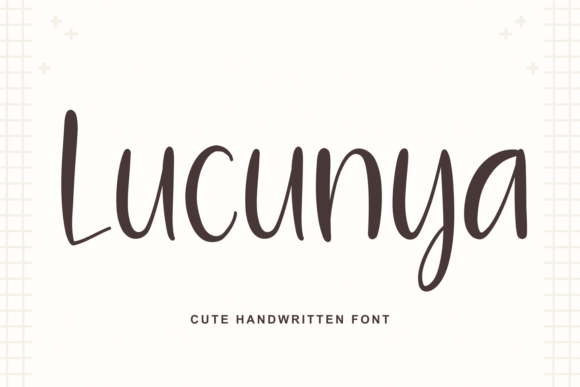
There’s that moment—right after you’ve poured your third candle of the day—when you pick up your design software to finalize the label. You scroll past ten fonts, then twenty. Some feel too stiff. Others are overused, or worse, try too hard to be “cute.” Then you open Lucunya, type “Honey Lavender,” and *breathe*. It’s like watching ink skip across paper—soft, bouncy, full of quiet confidence. Not perfect. Not polished. Just warmly, authentically alive. That’s Lucunya: a handwritten typeface from Script Amp that doesn’t imitate handwriting—it *honors* it.
What makes Lucunya special isn’t just its gentle wobble or the subtle lift at the end of each stroke—it’s how it carries intention. Every lowercase ‘a’ tilts just so; every capital ‘L’ has a soft curve that invites the eye to linger. It’s not a script font built for speed or automation. It’s made for moments where personality matters more than precision: a hand-stamped boutique tag, a wedding welcome board leaning against a farmhouse door, or the delicate script on a printable planner page that feels like it was drawn just for you.
I first used Lucunya on a set of seasonal candle labels—small 2” x 3” kraft stickers meant for soy wax tins. Because Lucunya is designed with generous letter spacing and open counters (those little enclosed spaces inside letters like ‘e’ or ‘a’), it stayed legible even at 14pt on matte sticker stock. No pixelation. No cramped tension. Just soft clarity. For physical products like these, readability isn’t just about size—it’s about rhythm. Lucunya’s natural variation in stroke weight and baseline sway actually helps the eye track words smoothly, especially in short bursts like scent names (“Sage & Sea Salt”) or collection titles (“Spring Gatherings”).
It shines brightest where warmth and approachability matter most: greeting cards, wedding invitations, boutique packaging, and digital printables. On a watercolor-style birthday card, Lucunya’s gentle bounce echoes the joy in the illustration—not competing, but complementing. On a printable wall art sheet for nurseries or cozy reading nooks, it adds tenderness without looking childish. And for digital downloads—like editable Canva templates or layered Procreate files—Lucunya gives instant creative polish. Customers don’t just see a font; they feel the care behind the design.
That said, Lucunya isn’t meant for long paragraphs or dense product descriptions. It’s a display font—a premium font built for impact, not endurance. Think titles, headers, names, quotes, and decorative phrases. It works beautifully as a focal point paired with a clean sans serif (like Montserrat or Inter) for body text, or alongside a simple serif (such as Lora or Merriweather) for contrast that feels intentional, not accidental. I often use it for the main headline on a tote bag mockup, then switch to a light-weight sans for the small tagline underneath—balance, not blending.
For crafters using Cricut Design Space or Silhouette Studio, Lucunya cuts cleanly when converted to outlines—and because it’s well-hinted and includes OpenType features, ligatures and stylistic alternates stay intact when exported as SVGs or PDFs. Just remember: always check the included file formats (OTF, TTF, WOFF) and confirm commercial licensing before adding Lucunya to physical merchandise, shop branding assets, or editable template bundles. Script Amp fonts like Lucunya are licensed for both personal and commercial use—including printed goods, digital downloads, and social media graphics—but verifying multilingual support (if you use accented characters) and checking for swashes or contextual alternates can save time later in production.
Real-world uses keep surprising me. Last month, I tested Lucunya on a set of mini chalkboard-style gift tags—printed on textured cardstock and tied to ceramic mugs. The font’s slight irregularity mimicked real chalk marks, making each tag feel handmade—even though it was digitally designed. Another week, I used it for the “Welcome” header on a wedding invitation suite, pairing it with a thin serif for the couple’s names and date. Guests commented on how “inviting” the stationery felt—not just pretty, but emotionally resonant. That’s Lucunya’s quiet power: it doesn’t shout. It leans in.
It also adapts gracefully to seasonal shifts. In fall, it softens rustic packaging with phrases like “Pumpkin Spice & Quiet Evenings.” In spring, it lifts botanical-themed wall art with lines like “Grow gently.” And during holiday prep, it wraps around ornament tags and mug designs with the same sincerity—never saccharine, never forced. Because Lucunya isn’t trend-driven. It’s human-driven.
One practical note: if you’re designing for small-format items—like 1” round stickers or tiny jar labels—stick to short phrases (3–5 words max) and avoid tight kerning adjustments. Let Lucunya breathe. Its charm lives in the space between letters, not in compression. And when previewing mockups for Etsy listings or Instagram posts, view Lucunya at actual size—not zoomed out. Its personality reveals itself best up close, where you can see the fine details: the tapered terminals, the organic entry/exit strokes, the way the lowercase ‘g’ curls just enough to feel familiar.
Whether you're printing tea towel labels, laying out planner undated pages, or building a cohesive brand identity across mugs, shirts, and digital templates, Lucunya brings cohesion through character—not conformity. It reminds customers that behind every product is a person who chose thoughtfully, designed intentionally, and valued feeling as much as function. That’s not just typography. That’s storytelling—in every curve, every wobble, every letter.
- Use Lucunya for candle labels, greeting cards, wedding stationery, and printable wall art
- Pair it with a clean sans serif for balance in packaging, tags, and digital templates
- Keep phrases short and legible—ideal for display use, not long-form text
- Verify commercial licensing and file formats before selling physical or digital products
- Test readability at actual print size, especially for stickers, labels, and small-format merch