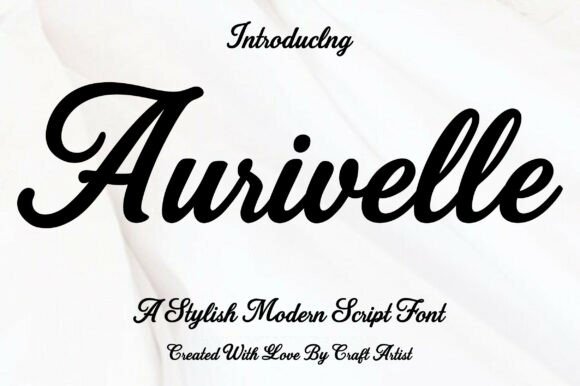
Aurivelle: A Modern Script Font That Elevates Handmade Design
There’s a quiet magic in the moment you type “Lavender Honey” into your design software and watch it bloom across the screen in Aurivelle. I was finalizing candle labels for a spring collection—soft cream kraft paper, matte gold foil accents—and something about that first curve of the lowercase “l” felt *right*. Not just pretty, but intentional. Like the font already knew the story my brand wanted to tell: warm, thoughtful, quietly luxurious.
Aurivelle is a modern script font built for makers who care about texture, tone, and tactile detail. Its strokes flow with smooth, confident curves—not fussy or overly ornate, but gracefully tapered and balanced. There’s a gentle rhythm to it, like handwriting slowed down just enough to savor each letter. It leans feminine without being fragile, elegant without feeling distant. That balance is why it works so well across handmade goods: whether printed at 8pt on a tiny gift tag or scaled large across a wooden welcome sign, Aurivelle keeps its poise.
I’ve used it most often for short, high-impact text—product names, collection titles, greeting card headlines, and wedding invitation monograms. On candle labels, it gives even simple scents like “Vanilla & Sea Salt” a subtle sense of occasion. For printable wall art, pairing Aurivelle with a soft neutral background and delicate line art creates instant cohesion. And when designing digital planner pages or seasonal sticker sheets, its natural swash alternates (like the extended tail on the capital “Q” or looping “Y”) add just enough personality without overwhelming clean layouts.
It’s not meant for long paragraphs—and that’s part of its strength. As a display font, Aurivelle shines where attention matters most: the name stitched onto a linen tote bag, the “Thank You” stamped on a boutique packaging insert, the “Est. 2023” on a ceramic mug’s base. Its readability holds up beautifully on physical products, especially when printed at 10pt or larger. For Cricut or Silhouette users, I’ve found it cuts cleanly on vinyl and heat transfer material—just avoid ultra-thin swashes at very small sizes (under 6pt) on intricate stickers or tiny tags.
What makes Aurivelle feel so versatile in practice is how easily it pairs with other typefaces. I almost always pair it with a relaxed sans serif—something airy like Montserrat Light or Poppins Regular—for body text, ingredient lists, or shop policy notes. That contrast lets the script breathe while keeping information clear and grounded. For wedding stationery, I’ll sometimes layer it over a delicate serif like Cormorant Garamond for a layered, editorial feel. The key is letting Aurivelle lead the emotional tone, then supporting it with type that serves function without competing.
In my own workflow, Aurivelle has become essential for seasonal shifts. Last December, I designed holiday gift tags using its bold alternate capitals for “Joy” and “Gather,” then softened the rest with hand-drawn snowflakes and minimalist borders. For spring planner bundles, I used its ligatures (“fi”, “fl”, “ct”) to create custom headers like “Fresh Start” and “Bloom Daily”—small details that make digital downloads feel thoughtfully crafted, not templated.
Before using Aurivelle commercially—whether on physical product labels, SVG files for crafters, or editable Canva templates—I always double-check what’s included in the file package. The version I use comes with OpenType features: standard and discretionary ligatures, contextual alternates, and a full set of swashes. It supports Latin-based languages (great for US, Canadian, and EU sellers), and the .OTF and .TTF files install smoothly across Mac and Windows. Most importantly, its commercial license covers resale of physical goods and digital downloads—no extra permissions needed for Etsy listings or print-on-demand mugs and totes.
One thing I appreciate as a maker is how Aurivelle subtly reinforces perceived quality. When customers see that refined script on a candle label or greeting card, they don’t just read the words—they register care. It signals intention behind the making, not just the materials. That emotional resonance carries through to social media previews too: mockups with Aurivelle consistently get more saves and slower scroll stops in my feed—proof that typography isn’t just decoration; it’s silent brand storytelling.
Of course, context matters. I wouldn’t use Aurivelle for a rugged farmhouse sign with distressed wood grain—it would feel out of place. But for a delicate botanical wedding welcome board? Absolutely. For a soft-pink baby shower invite? Perfect. For a minimalist black-and-white sticker sheet celebrating small joys? Yes—especially when paired with subtle dot grids or fine-line illustrations. Its charm lives in harmony, not dominance.
If you’re choosing fonts for your shop’s next batch of labels, cards, or digital printables, ask yourself: What feeling do I want someone to feel before they even smell the candle or open the card? With Aurivelle, the answer often lands somewhere between calm confidence and quiet celebration. It doesn’t shout. It invites. And in a crowded handmade market, that kind of gentle distinction is exactly what helps real people pause, connect, and choose your work.
Whether you're sketching ideas on paper or fine-tuning a mockup at midnight, Aurivelle is the kind of script font that feels like a collaborator—not just a tool. It remembers the weight of handmade, the warmth of personal connection, and the quiet power of getting the details right.